Welcome to July! It’s hard to believe that we are already halfway through 2020. Do you also feel like this year is really testing the limits of how well we are coping with change, uncertainty, stress and how well we are attuned to our emotional landscape through all of this? In this blog I’ll share my personal half-year check-in and we’ll look into the nature of stress and how to build resilience.
In Australia, we experienced a devastating bushfire season at the end of 2019 and into January 2020. I live in a rural area in the middle of a national park and after spending most of my life in Europe, I have never experienced bushfires before and had to learn how to prepare for this danger to my physical safety. We had several months with a weather pattern that exposed us to one or two days of extreme fire danger every week with over 40 degrees and strong winds. On the news, they were showing how quickly and unpredictable the fires were spreading in coastal communities just like the one where I live. I slept very lightly, was always on alert and woke up at night to the smell of fire and smoke in the air. The smoke and embers traveled over long distances forcing me to stay inside to avoid the effects of the smoke burning in my eyes and lungs. I wore a face mask when I had to go out. This all feels like this was ages ago now.
Soon after the bushfire emergency, the world was thrown into a global pandemic. Apart from the potential risk to our own physical health and the health of vulnerable members of the community, for many people the COVID-19 pandemic comes with financial uncertainty, isolation, loneliness, separation from family & friends, and missing out on regular lifestyle routines like going to concerts, theatres and restaurants etc.
So, how can we navigate these unprecedented, uncertain times?
Firstly, let’s take a closer look at the nature of stress and what it does to our body and brain.
There are two different categories of perceived stress:
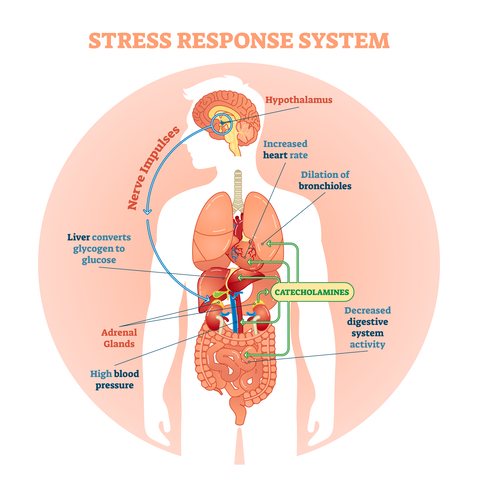
- Physical stress can be due to accidents, blood loss, natural disasters and will trigger a fast response to an acute danger that will trigger the release hormones like cortisol and adrenalin. Our heart rate goes up, digestion slows down, more blood flows to the muscles to prepare us for a “fight or flight” response and the liver will increase the production of glucose to get the body energy to act. The body quickly goes back to baseline once the physical stress is over.
- Psychological stress such as work deadlines, social rejection, loneliness, negative thoughts, perceived failure etc. trigger a slower and longer lasting stress response that can easily turn into chronic stress, where our body does not easily get back to baseline resulting in high cortisol levels for some individuals or fatigue and a lack of cortisol at the other end of the spectrum.
As individuals we all have a very different threshold to stress based on our life experience, memories and genetic predisposition. We are particularly vulnerable to stress at different points in our lives, especially during periods of massive change and sudden transition. I’m sure 2020 qualifies for both massive and sudden changes for many people. Chronic stress can lead to a range of health issues, e.g. depression, short-term forgetfulness, cognitive decline and a higher risk of Alzheimers disease.
It’s important to note that not all stress is bad for us. A certain amount of stress and tension is good for us to achieve goals and learn new skills through personal challenge. (TED talk for reference). We don’t have control over many of the triggers for stress (stressors) but we can learn how to deal better with stressful events, become more resilient and turn adversity into advantage:
Here are some tips how to build resilience:
- Exercise,
- Social support network
- Self-care and self-compassion
- Sleep (more info on the
Life Balance Project Sleep Blog)
- Managing emotional response (e.g. journalling)
- Creating a sense of purpose and autonomy
- Create a positive mindset & thoughts
- Mindfulness, meditation & relaxation
And in the words of Banksy’s latest artwork on the London tube:
“I get lockdown, but I get up again” (Banksy on YouTube)
For those interested in how we can use meditation techniques to counter stress and build resilience I invite you to check out my 5-Week Meditation Intensive starting Monday July 20th at 6:30pm (Sydney time).
Meditation and mindfulness are powerful tools that help me navigate these unprecedented and challenging times.

I started my meditation journey more than 20 years ago and practiced a variety of meditation and mindfulness techniques. I developed a deep knowledge and understanding of the benefits of meditation including the latest neuroscience research and I’m very excited to share this 5-Week Meditation Intensive online course with you for the first time. All sessions will be live and you can access the recordings via a private Facebook Group.
Take care and carry on, carrying on!
Lots of love,
Sandra
 Life Balance Project