by Sandra Sperber
Welcome to 2021! Is your email inbox and social media feed full of tips for New Years’ resolutions, 21 or 30 days programmes to change your diet, exercise programme, yoga practice, etc.?
Most programmes are based on the assumption that we can create a new habit in just 21 days. Wouldn’t that be wonderful? Unfortunately, it is probably going to take much longer than that unless it’s a very simple habit. According to statistics, 25% of New Years’ resolutions are gone by mid January and only 8% are kept until the end of the year.
Before I share some simple tips on how you can make or break a habit with you, let me explain a bit more about the nature of habits and what happens in our brains. It’s very useful to understand the biology and why willpower and motivation are not essential to change. It’s actually your environment that matters more. Understanding how habits are formed in the brain and making a plan can help you to change without relying on our willpower alone.
Habits automated behaviours that we learned and they are hardwired in our brains. By performing certain sequences of behaviour (or thoughts) we make our brains more efficient and reducing the mental load. We perform these action in auto-pilot mode without even thinking and we can use the time to do other stuff like writing a blog or inventing electrical cars for instance. Steve Jobs is said to have perfected habits and routines like wearing black turtle neck jumpers every day to reduce the mental load of thinking about what to wear.
This becomes very useful for skills like driving a car but there are habit that we might want to get rid off. Unfortunately, our brain treats all habit equally and neutral. That’s why it can be challenging to change habits that are not so good for us. In order to stop habits we can use the same principle and disrupt our autopilot mode by practising mindfulness and meditation. Let’s have a look at the four stages of habit formation:
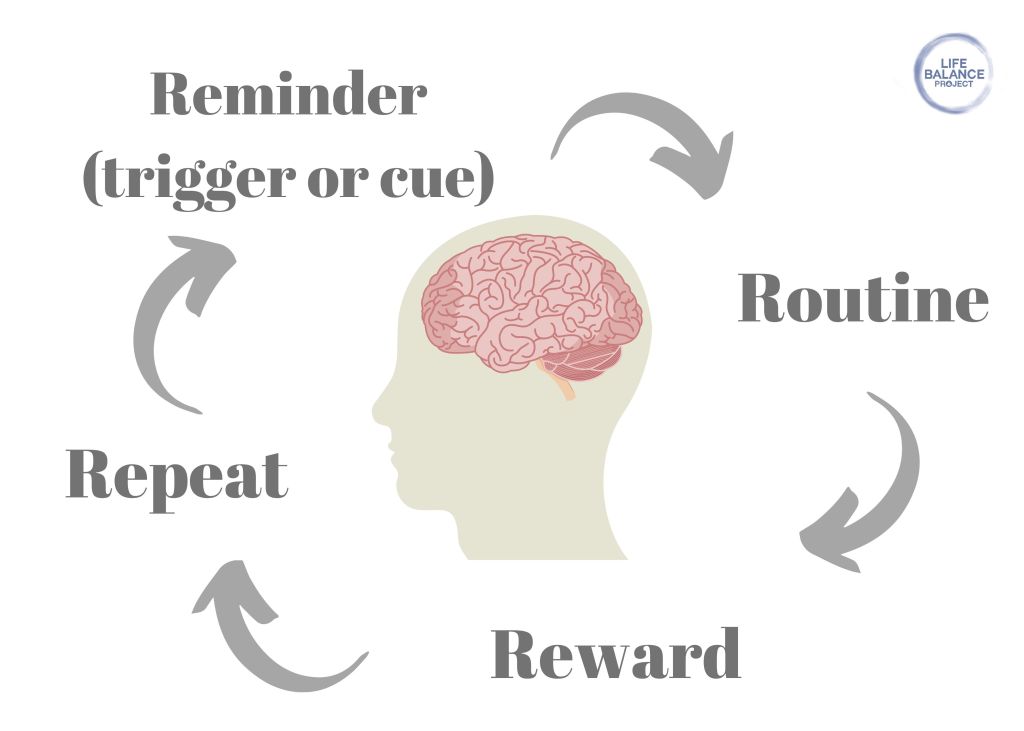
This model can help us to tackle the difficult task of change. Understanding the mechanism gives you choices to make long-lasting change. Once you are aware of your trigger (or cue), maybe try to replace the routine (habit) with a healthier choice. Create a system of change rather than focussing on short-term goals, think about rewarding yourself. Repetition is key for habit formation.
Here are my top 10 tips:
- You can start small with the two-minute rule. It’s easy to stick to a habit that you can commit to. A tiny change can lead to remarkable long term benefits but patience and perseverance is key. If you want to write a book maybe you can commit to writing one page a day? If you want to meditate every day, try starting with just two minutes.
- Add a desired habit to something you are already doing. It’s called habit stacking. So maybe you can go for a walk while chatting on the phone to a friend or listen to your favourite podcast.
- Plan and prepare “what if” scenarios for any obstacles that might occur. For example: I’m going for a run in the morning, if it rains, I’m doing stretches instead. Be specific: I’m going to run in the morning on Monday, Wednesday and Friday before work.
- Start tracking your habits with a list or journal. Ticking boxes gives you a sense of achievement and keeps you motivated. Don’t forget to reward yourself. (Sign up here to receive your free habit tracker template via email).
- Your habits shape your identity and vice versa: Changing habits is really about becoming the person you want to be. Instead of saying: I’m meditating regularly, you can say, I’m a meditator. Instead of saying: I’m running my own business you can say, I’m an entrepreneur.
- Habits are more effective than setting a concrete goal. Recent research shows that there are advantages of setting “open goals”. Achieving goals is a momentary change and doesn’t necessarily lead to a long-term change. Setting a specific goal can also lead to frustration.
- Make your new habit irresistible by making it simple, obvious and appealing. You can reduce friction to create a new habit. If you want to go for a run in the morning, put all your gear out in the evening so you don’t have to think about it in the morning. If you keep forgetting to take your supplement or medication, put them in front of the coffee machine, for example.
- Behaviour is predictable: It doesn’t take any of my willpower (anymore) to avoid that aisle in the supermarket. I just don’t go there. It’s useful to know that businesses are using the science to make us buy more. Marketing researcher found out that when they put the healthy food and veggies at the entrance you’re more likely you buy snacks and processed food once you’ve put our veggies in the trolley.
- Think about your why: If you want to go to the gym five times a week- you could rephrase your goal to: I want to get stronger. If you are aiming to lose weight – maybe change your goal to: I want to be healthy. If you want to start with a meditation practice maybe change your goal to “I want to feel calm”. You get the idea.
- I’ve saved the best one for last: approach your habits with gratitude. Be thankful that you can make choices. Think of the people that support you to become the best version of yourself. According to psychologist David DeSteno, making gratitude a habit is a superpower. When you just rely on habits and discipline it can actually cause a lot of stress and problems of dealing with failure. If you build a habit to cultivate gratitude it will help you to value the future more than the present and making better decisions for yourself in all areas of your life. Practising gratitude and compassion is part of many religious and spiritual practices especially in Buddhism. There are many studies about the overall benefits for our health and wellbeing.
I hope you found plenty of inspiration on how to create lasting change in your life. Many of our habits are triggered by emotions. Practicing paying attention and mindfulness can help to observe your emotions in a non-judgemental way and can help you to break the auto-pilot loop. Why not take a deep breath and decide if the habit is serving you or not.
Wishing you all the best towards a successful 2021,
Sandra
Further reading:
James Clear: Atomic Habits
Charles Duhigg: The Power of Habits
If you have any questions, or want to get in touch contact me via:
lifebalanceproject@gmail.com
(c) Life Balance Project 2021
 Life Balance Project